
Termites Are Called Silent Destroyers for a Reason - Here Is Why
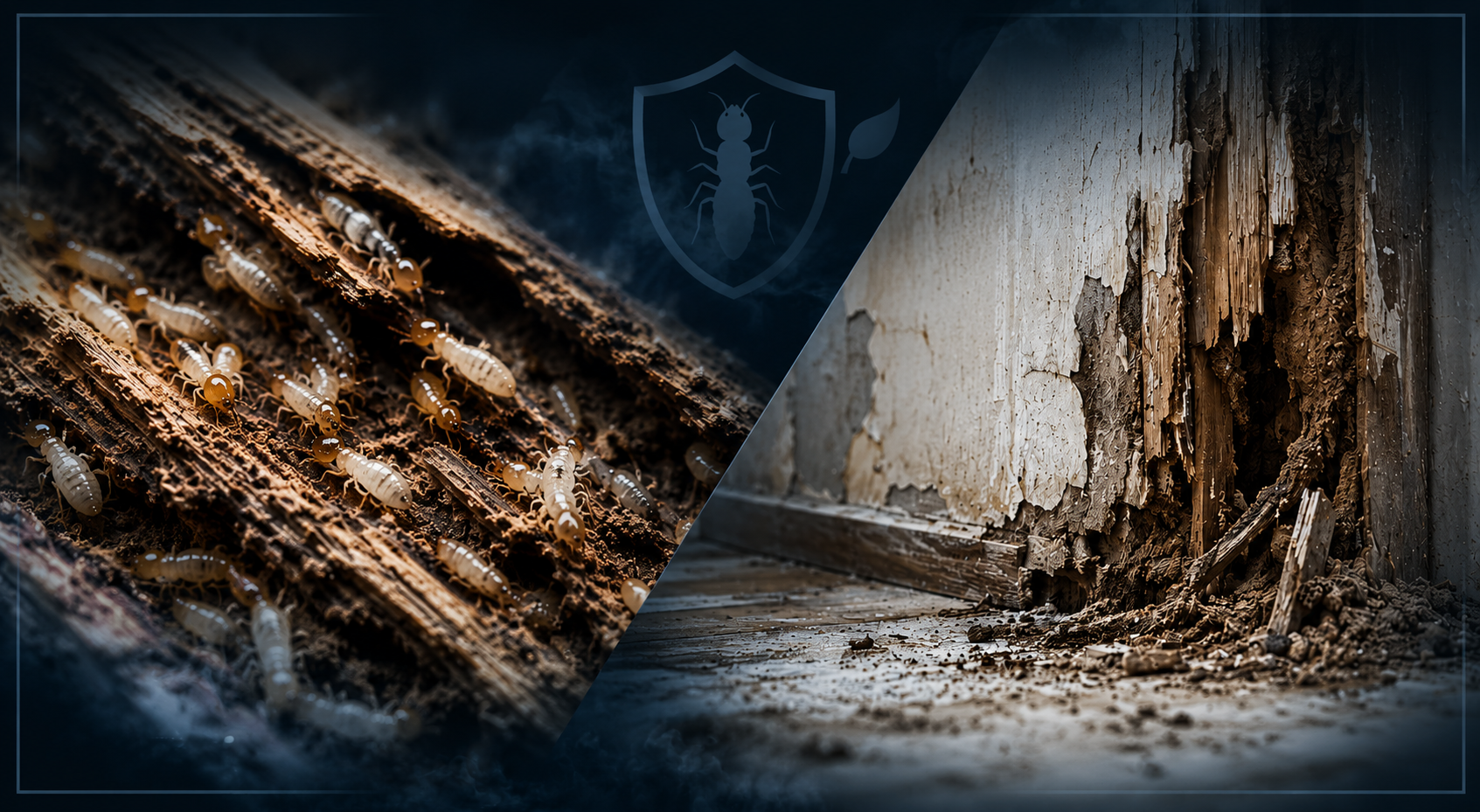
There is a particular nickname in the pest control world that earns its meaning every single day, in hundreds of thousands of homes across the United States. Silent destroyer termites is not just a dramatic label invented by exterminators to sell more services. It is an accurate biological description of how these insects operate, how they feed, how they hide, and how they manage to cause more property damage annually than fires, floods, and storms combined, while going almost completely undetected until the worst has already happened.
Termites cause an estimated five billion dollars in termite damage home repairs and prevention costs across the United States every single year. Around 600,000 residential properties are affected annually. The average homeowner who discovers an infestation faces repair bills averaging three thousand dollars, and that is for a relatively contained problem. Structural infestations can cost tens of thousands more. And in the vast majority of cases, homeowners' insurance does not cover a single dollar of it, because insurers classify termite damage as a preventable condition rather than an accidental loss.
So how does a pest this destructive stay hidden for so long? The answer lies in the biology, behavior, and feeding strategy of the termite itself. Understanding why they are so difficult to detect is the first step toward catching them before they do the kind of damage that redefines the word "expensive."
The Biology Behind the Silence
Termites do not behave like most household pests. Cockroaches scatter when the lights come on. Rodents leave droppings in visible areas. Ants march in lines across kitchen countertops. Termites do none of these things. Their entire existence is structured around staying out of sight, and their biology is specifically adapted to make that possible.
Subterranean termites, the most destructive and widespread species in the United States, live entirely underground. Their colonies can contain hundreds of thousands of individual insects operating through an elaborate tunnel system that may extend twenty feet below the surface. Worker termites, the ones actually responsible for termite damage to your home, are blind. They navigate entirely through pheromone trails and vibration signals, never surfacing into open air. They eat wood from the inside out, hollowing it methodically while preserving a thin outer shell that keeps the structure looking intact from the outside.
This inside-out feeding strategy is one of the core reasons termite damage goes undetected for so long. A floor joist, wall stud, or support beam can be consumed to near-structural failure while looking completely normal from every accessible angle. The surface is fine. The integrity beneath it is gone.
Formosan termites, a particularly aggressive invasive species found across the Southeast including Georgia and Tennessee, take this further still. Formosan colonies can number in the millions. A mature Formosan colony can consume a pound of wood every single day. They also construct carton nests — moisture-retaining structures built inside wall cavities from chewed wood and soil — which allow them to maintain their colony entirely within your home's structure without any soil contact at all, making the usual surface-level termite signs like mud tubes far harder to identify.
Why Termite Damage Goes Undetected for Years
Most homeowners who discover a termite infestation are not finding it early. They are finding it after years of activity. Research consistently shows that the average subterranean termite colony takes three to five years to grow large enough to produce the swarmers that homeowners sometimes notice in spring. By the time those winged insects appear near your windows or on your porch, the colony responsible has almost certainly been feeding inside your home's structure for years already.
The swarm is not the beginning of the problem. It is a sign that the problem is already well established. By the time termites produce swarmers, the colony has reached maturity — meaning it has been actively feeding on your property's wood structure for a significant period.
This timeline matters enormously for homeowners. A colony that has been active for two or three years before detection has had time to move through floor joists, wall framing, roof support members, and the wooden components that surround plumbing and electrical systems. The termite damage at that stage is rarely limited to one area. It is distributed through the structure wherever the colony extended its foraging tunnels, often in areas the homeowner has never had cause to inspect.
The problem is compounded by the fact that most of the places termites prefer to feed are exactly the places homeowners never look: inside wall cavities, beneath subflooring, inside the wood framing around window and door openings, in crawl spaces, and along the foundation sill plate. These are areas a professional inspection covers systematically. They are not areas that come up during the average homeowner's routine.
What Termite Signs Actually Look Like
Part of what makes silent destroyer termites so difficult to catch is that the warning signs they do leave behind are subtle, easy to misattribute to other causes, and in many cases only visible in areas homeowners rarely examine. Here is what a trained inspector is looking for, and what homeowners should know to watch for between annual inspections:
Mud tubes: Pencil-width tunnels made from soil, termite saliva, and debris running along foundation walls, interior walls, floor joists, or any surface connecting soil to wood. These are the transit highways subterranean termites build to travel between their underground colony and their food source. Finding one is among the clearest indicators of active subterranean termite activity.
Hollow-sounding wood: When termites feed from the inside out, the surface layer of the wood remains intact while the interior is consumed. Tapping baseboards, door frames, structural beams, or flooring and hearing a hollow, papery resonance instead of a solid knock is a classic sign of termite damage beneath the surface.
Discarded wings near entry points: After swarming, reproductive termites shed their wings within minutes of landing. Finding small piles of equal-length, translucent wings near windowsills, door thresholds, or on interior floors is a strong indicator that a swarm has recently occurred — meaning a mature colony is active nearby.
Tight-fitting doors and windows: As termites consume wood framing and moisture accumulates within damaged wood structures, the resulting warping and swelling can cause doors and windows to stick or become difficult to open. This is often dismissed as a humidity or settling issue when the actual cause is structural wood damage.
Frass: Drywood termites push their waste out of the wood as small, six-sided pellets that accumulate in small mounds below infested areas. These pellets are roughly the size and appearance of sawdust or coffee grounds and are frequently found near door frames, window sills, or beneath infested furniture.
Blistered or bubbling paint: The moisture produced by termite activity and the micro-galleries they create beneath painted surfaces can cause paint to bubble, crack, or peel in patterns that closely resemble water damage. Many homeowners investigate for leaks and find none, not realizing the source is termite activity behind the wall.
Sagging floors or ceilings: In advanced infestations, the structural compromise becomes physically apparent. Floors that feel spongy underfoot, ceilings that develop unexplained soft spots, or any visible sagging in a horizontal structural element should be treated as a serious warning requiring immediate professional evaluation.
These are the termite signs that a licensed technician is trained to identify and interpret. The challenge is that most of them individually can be mistaken for normal wear, moisture issues, or settling — which is exactly why having a professional conduct a systematic inspection is the only reliable way to know what you are actually dealing with.
The Hidden Dangers Beyond Structural Damage
When homeowners think about termite damage, the instinct is to picture weakened wood. But the damage termites cause extends well beyond structural integrity. An advanced termite infestation creates a cascade of secondary risks that compound the original problem significantly.
Electrical hazards: Termites are known to chew through the insulating coating on electrical wiring inside wall cavities. Exposed or compromised wiring is a fire risk, and in many cases the connection between a structural fire and prior termite activity is never identified because the evidence burns along with the structure.
Mold and moisture damage: The foraging tunnels termites build inside wood trap moisture and disrupt ventilation within wall cavities. Over time, this creates conditions where mold colonies establish themselves alongside the termite infestation. The resulting moisture damage can affect insulation, subfloor materials, and drywall independently of the wood damage itself.
Compromised HVAC ducting: In crawl space and attic installations, termites have been found to damage flexible duct connections and insulation wrapping, reducing system efficiency and creating air quality issues that homeowners typically attribute to aging equipment rather than pest activity.
Foundation and masonry: While termites do not consume concrete or brick, they exploit cracks and expansion joints in foundation masonry as entry points. Their foraging activity can widen hairline cracks over time, and the moisture associated with active colonies accelerates mortar deterioration in older foundation systems.
Why the South Carries Elevated Risk
The reason silent destroyer termites are so consistently damaging across Georgia and Tennessee specifically comes down to climate. Both states sit within the termite belt — the band of the American South where year-round warmth, seasonal rainfall, and high humidity create conditions where termite colonies never fully enter the dormant-like state that cold northern winters impose on them. Georgia's clay-heavy soil retains moisture across most of the year. Tennessee's mild winters allow colonies to remain active and feed continuously even in months when northern homeowners have stopped thinking about termites entirely.
Properties in the Atlanta metro area, including Marietta, Alpharetta, Roswell, Buckhead, and Norcross, face year-round subterranean termite pressure. Properties across greater Nashville and Middle Tennessee, including Brentwood, Franklin, Smyrna, and Murfreesboro, sit in comparable risk territory. In both regions, there is a saying among pest professionals that is bluntly accurate: there are two kinds of homes — those that have termites, and those that are about to.
The One Thing That Changes the Outcome
The biology of silent destroyer termites means that self-inspection is not a reliable defense. The areas termites occupy and the damage patterns they create require a trained eye, professional tools, and systematic coverage of the specific zones where early-stage activity is most likely to be detectable. A licensed inspector knows where to probe, what surface patterns indicate damage behind a wall, how to read moisture meter readings within wall cavities, and how to distinguish active from prior infestation.
Annual professional inspections — ideally timed to spring, when colonies are at their most active and swarm evidence is fresh — are the difference between catching a manageable early-stage problem and discovering an advanced structural infestation after years of undetected feeding.
VerdX Pest Control provides year-round termite protection backed by a full warranty. Our annual protection agreement gives homeowners ongoing monitoring, scheduled inspections, and complete warranty coverage — all structured around affordable monthly installments so there are no large upfront costs to worry about. If you notice any pest activity between your scheduled visits, VerdX returns at no additional charge. That is not a policy we advertise as a bonus feature. It is simply what standing behind your service looks like in practice.
Whether you need residential pest control services or commercial pest control coverage, the process starts the same way: a free, systematic professional walkthrough of your property conducted by licensed specialists across our Atlanta and Nashville service areas. That inspection gives you a clear, accurate picture of where things stand — and what it will take to protect your property going forward.
The termite signs are there long before the damage becomes visible. The only question is whether a trained professional finds them first, or whether the structure does. Contact VerdX Pest Control today to schedule your free inspection, or get an instant quote online and stop the silent destroyers before they go any further. We can treat your home for ants, cockroaches, fleas, ticks, bed bugs, and more.
